

Amazfit has launched the T-Rex Dual Solar, a 51mm outdoor watch that pairs an AMOLED display with solar charging on both the front and the back. It is listed at $649.99 in the U.S., $100 more than the T-Rex Ultra 2. Full product details are on Amazfit’s T-Rex Dual Solar page.

Amazfit T-Rex Dual Solar in Basalt Black. Photo: Amazfit.
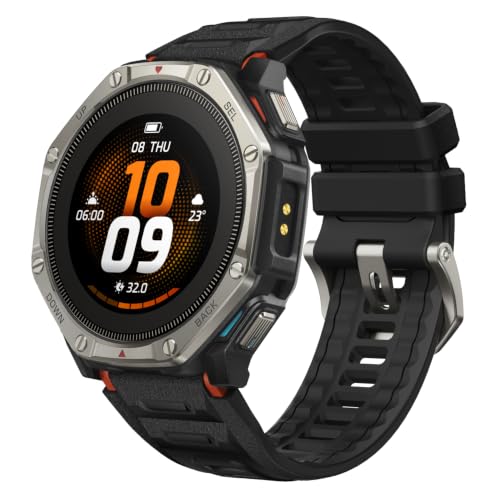
Amazfit is calling it the first dual-sided solar charging system on an AMOLED smartwatch. The front collects energy through the display. The rear uses a glass-ceramic back plate that Amazfit says has more than twice the active charging area of the front. The company says the two surfaces do not charge at the same time. When the rear panel sees sunlight, the watch can enter a Solar Boost mode that locks the rest of the interface until you exit it.
That combination is the part Garmin has stayed away from. Garmin’s position has been that AMOLED plus solar does not make sense on power, and that the space is better used for a larger battery.
Hardware
The Dual Solar is built as a close twin of the T-Rex Ultra 2, with a few hardware tradeoffs:
- 1.32-inch AMOLED, 466 × 466, up to 3,000 nits, sapphire crystal
- 660 mAh battery, versus 870 mAh and a 1.5-inch display on Ultra 2
- Case 51.4 mm across and 16.9 mm thick including the heart-rate sensor; watch body 69 g
- Grade 5 titanium bezel and buttons, fiber-reinforced polymer frame, Grade 5 titanium and glass-ceramic back
- 10 ATM, with recreational dive support to 50 meters (Ultra 2 is 45 meters)
- White or red flashlight (Ultra 2 is white or green)
- Dual-band GPS, preloaded maps, route planning, 180+ sport modes
- Microphone, speaker, Bluetooth calls
- Low-temperature mode down to -30°C / -22°F
- Side USB-C-compatible charger that is not the same connector as other current Amazfit watches
- Color: Basalt Black

Amazfit official battery claims. Photo: Amazfit.
Official Battery Claims
Amazfit’s own compare table lists:
- Typical use: up to 25 days
- Typical use plus 3 hours of front solar: up to 34 days
- Typical use plus 3 hours of rear solar: up to 51 days
- Accuracy GPS mode: up to 41 hours
The solar figures assume three hours of sunlight at 50,000 lux.

The Dual Solar solar widget, split by front and rear input. Photo: Amazfit.
How the Battery Actually Behaved
Ray Maker tested a review unit in a September 22, 2026 hands-on at DC Rainmaker. His numbers are much smaller than the marketing claims.
Off the wrist in all-day sun, he saw about 2–3% of battery added. One day went from 53% to 55% between about 9:45 a.m. and 3:15 p.m. Another day the watch listed 2.8 days of smartwatch time, 8.4 days of battery-saver time, and 14 days of watch-only time, with repeated overheat warnings.
The rear panel is the bigger collector, but it also runs hot. In 80–90°F weather, Maker said it overheated in about 10 minutes, then stopped adding charge until it cooled. Amazfit told him cooler alpine temperatures should hold up better.
On the wrist with GPS, solar did not change the draw much. A night ride of 1 hour 20 minutes went from 45% to 42%, about 2% per hour, with no solar. A sunny one-hour run went from 43% to 41%, also about 2% per hour. A sunny 2-hour 12-minute ride went from 51% to 46%, and the watch showed zero solar during that activity. Amazfit is looking into that. One theory is that the watch selected the rear panel while it was against his wrist.
Maker did confirm the watch can restart from 0% on solar alone. He also said Amazfit’s solar widget is clearer than Garmin’s: it splits front and rear input, and it shows days gained in smartwatch, battery-saver, and watch-only modes. It does not subtract the power the watch is using at the same time.
His conclusion: Amazfit had to shrink both the battery and the display to fit the solar hardware, and the real-world gain on the wrist is small.


No comments yet. Start the conversation.