

The Garmin Forerunner series offers a range of features to suit different fitness needs and budgets. Garmin has three main products in the series, which increase in features and cost as the number increases: the 165, the 265, and the 965. This guide breaks down the critical hardware and software differences between the Forerunner 165, 265, and 965 to help you decide which model is right for you.

Cost
As you move up the line, the watches gain capabilities and increase in cost:
- Forerunner 165: $249.99 ($299.99 for the music edition)
- Forerunner 265: $449.99, available in two sizes (265 and 265S)
- Forerunner 965: $599.99
Hardware Differences
Screens and Sizes
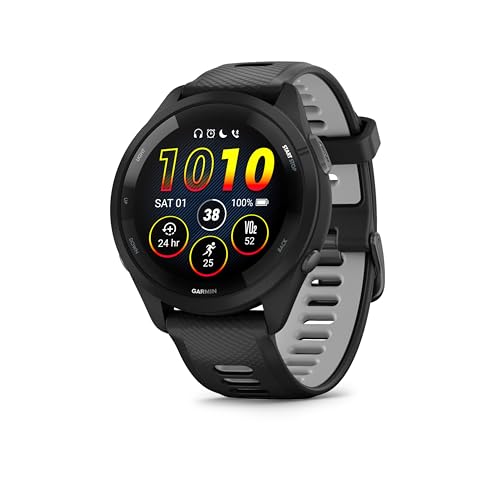
All of the watches have an AMOLED display. The Forerunner 165 and 965 come in a single size, while the 265 offers two different sizes. The 965 has the largest screen, which may not be ideal for those who prefer smaller watches or have smaller wrists.
| Model | Sizes | Screen Size |
|---|---|---|
| Forerunner 165 | 43mm | 1.2-inch AMOLED |
| Forerunner 265 | 46.1mm (standard), 41.7mm (265S) | 1.3-inch, 1.1-inch AMOLED |
| Forerunner 965 | 47.2mm | 1.4-inch AMOLED |
Body and Lens Materials
Body: All Forerunner models feature a fiber-reinforced polymer (plastic) body, making them lightweight and durable. The 965 has a titanium bezel, giving it a more premium appearance than the polymer bezels on the 165 and 265.
Lens: The Forerunner 165 is equipped with chemically strengthened glass, while the Forerunner 265 and 965 feature Gorilla Glass, which is harder and scratch-resistant. Although all are sufficient to prevent cracks or scratches in most cases, the Gorilla Glass provides an extra level of durability.
Sensors
All Forerunner models are equipped with the same GNSS location tracking (GPS, GLONASS, Galileo), Garmin Elevate 4 wrist heart rate monitor, blood oxygen saturation monitor, barometric altimeter, compass, accelerometer, thermometer, NFC (Garmin Pay), and an ambient light sensor. However, only the Forerunner 265 and 965 include a gyroscope, which enhances activity tracking accuracy and helps auto-detect activities.
Multi-Band GNSS Support
Although all of the devices have the same location sensors, only the Forerunner 265 and 965 offer multi-band GNSS support, which enhances GPS accuracy in covered environments like cities or around trees. A Guide to GPS on Your Watch: Benefits of Multi-Band GNSS provides more details about these advantages.
Battery Life Comparison
As you move up the line, the battery life improves.
| Mode | Forerunner 165 | Forerunner 265 | Forerunner 965 |
|---|---|---|---|
| Smartwatch Mode | Up to 11 days | Up to 13 days | Up to 23 days |
| GPS-Only GNSS Mode | Up to 19 hours | Up to 20 hours | Up to 31 hours |
| SatIQ (AutoSelect) GNSS Mode | N/A | Up to 16 hours | Up to 22 hours |
| All-Systems GNSS Mode | Up to 17 hours | N/A | N/A |
| All-Systems GNSS Mode + Multi-Band | N/A | Up to 14 hours | Up to 19 hours |
Software Features Comparison
The software capabilities of each watch differ, especially in terms of advanced training metrics and activity tracking. While all models provide essentials like sleep monitoring, nap detection, recovery time, HRV status, and race predictions, features such as training status and readiness are reserved for the more premium models. As you move up the line, the watches support more activity types; for example, triathlon mode is exclusive to the 265 and 965, while team sports are only available on the 965. However, all watches include the most commonly used activities, such as running, hiking, cycling, and walking.
All models offer basic route guidance for navigation, but the Forerunner 965 stands out with detailed topographic maps for on-device navigation. The Forerunner 165 and 265, however, rely on breadcrumb-style navigation. The 965’s topographic maps provide detailed map data and are much more suitable for those who regularly rely on their watch for navigation.
Breadcrumb Navigation on Forerunner 265
 Full Topographic Maps on Forerunner 965
Below is a more comprehensive comparison of the software features of each watch model (this list is not exhaustive).
| Feature | Forerunner 165 | Forerunner 265 | Forerunner 965 |
|---|---|---|---|
| Sleep Score | ✔️ | ✔️ | ✔️ |
| Body Battery | ✔️ | ✔️ | ✔️ |
| Nap Detection | ✔️ | ✔️ | ✔️ |
| Recovery Time | ✔️ | ✔️ | ✔️ |
| HRV Status | ✔️ | ✔️ | ✔️ |
| Race Predictor | ✔️ | ✔️ | ✔️ |
| Training Effect | ✔️ | ✔️ | ✔️ |
| Music Storage | Optional ($50) | ✔️ | ✔️ |
| Training Status | ❌ | ✔️ | ✔️ |
| Training Readiness | ❌ | ✔️ | ✔️ |
| Exercise Animations | ❌ | ✔️ | ✔️ |
| Lactate Threshold Assessment | ❌ | ✔️ | ✔️ |
| Triathlon/Multi-Sport | ❌ | ✔️ | ✔️ |
| Cycling Power Meter Compatible | ❌ | ✔️ | ✔️ |
| Real-Time Stamina | ❌ | ❌ | ✔️ |
| Endurance Score | ❌ | ❌ | ✔️ |
| Hill Score | ❌ | ❌ | ✔️ |
| Heat & Altitude Acclimation | ❌ | ❌ | ✔️ |
| Golf Features | ❌ | ❌ | ✔️ |
| Onboard Maps | ❌ | ❌ | ✔️ |
Key Software Differences
- 165: Offers core health features like nap detection, recovery time, HRV status, and basic sports modes. However, it lacks advanced training tools such as Training Status and Training Readiness and has limited activity types. Music requires a specific support model.
- 265: This model adds some advanced training features like Training Status, Training Readiness, and Exercise Animations for strength workouts. It also supports multi-sport activities like triathlon and includes music storage by default.
- 965: The most feature-rich model, including all of Garmin’s latest training metrics, including endurance score, real-time stamina, hill score, golf tracking, and onboard maps for comprehensive navigation.
Which Forerunner is Right for You?
The Forerunner 165 is perfect for casual users or athletes seeking essential health and fitness tracking. This model is a budget-friendly option if you don’t need features like multi-band GNSS, advanced training metrics, onboard maps, or triathlon activities. However, remember that music storage requires an additional $50 upgrade.
The Forerunner 265, on the other hand, is ideal for people who want enhanced training metrics, a variety of sports modes, and improved GPS accuracy with multi-band GNSS support. Its availability in two sizes adds flexibility for those of different wrist sizes or watch size preferences.
For those seeking the most comprehensive features, the Forerunner 965 is the top-tier option. It encompasses all the capabilities of the 165 and 265, along with the complete set of advanced training metrics. Additionally, it boasts a more premium design with a titanium bezel, the largest screen, the best battery life, onboard maps, and golf tracking.
This guide should help you select the Forerunner model that best suits your fitness needs and budget by breaking down the key differences in hardware, software, and cost. While the official pricing of these devices is $249.99, $449.99, and $599.99, they are frequently discounted.



No comments yet. Start the conversation.