

The Garmin Forerunner series, introduced in 2003, has been a staple in GPS watches for runners, triathletes, and the fitness-forward. While it has evolved dramatically with advanced features and tools, its naming conventions haven’t always kept pace with its technological strides.

Forerunner 201, released in 2003, next to Forerunner 965, released in 2023
The early models—101, 201, and 301—followed a somewhat logical progression, though why Garmin started with “101” instead of simply “1” remains unclear. Things became less consistent with later models like the 205 and 305, then introducing two-digit numbers like the 60 (the 55 was released years later) and adding the XT designation to some models. XT, short for Cross Training, marked Garmin’s focus on triathletes by enabling tracking multiple activities in one session, including transition times, a strongly desired feature that solidified its appeal in multisport circles.
These many models allowed Garmin to innovate, but the various number schemes have often confused potential customers. Similar watches have vastly different numbers, making it harder to discern their place in the lineup. Below, you can see the model numbers for yourself.
Forerunner Model Progression from 2003 to 2024
101 -> 201 -> 301 -> 205 -> 305 -> 405 -> 310XT -> 60 -> 70 -> 110 -> 410 -> 210 -> 610 -> 910XT -> 10 -> 620 -> 220 -> 15 -> 920XT -> 25 -> 225 -> 230 -> 235 -> 630 -> 735XT -> 35 -> 935 -> 645-> 245 -> 45 -> 945 -> 55 -> 745 -> 945 LTE -> 255 -> 955 -> 265 -> 965 -> 165
A Shift Toward Structure
In recent years, Garmin has streamlined its Forerunner lineup into three distinct tiers: entry-level (1XX), mid-tier (2XX), and high-end (9XX), with features and prices scaling upward across the tiers. This organization makes it easier for customers to identify which watch best fits their needs. However, the number system could still confuse newcomers unfamiliar with Garmin’s ecosystem.
One notable shift is Garmin’s effort to make multisport functionality more universal. Previously, multisport tracking—critical for triathletes—was exclusive to high-end models like the 9XX series or XT watches. Today, multisport mode is available in mid-tier models, making advanced features more accessible while still distinguishing entry-level watches.

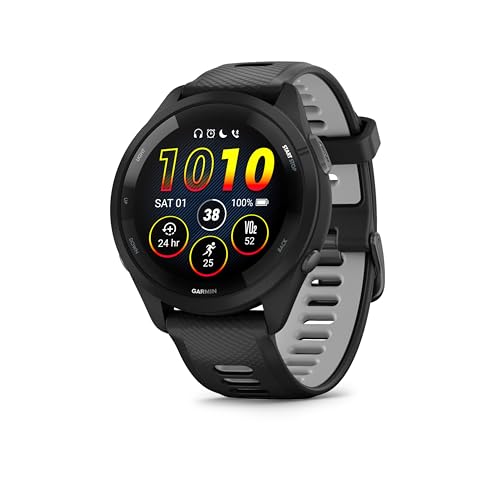
Garmin’s current Forerunner Lineup: 165 (Left), 265 (Middle), and 965 (Right)
The Entry-Level (1XX)
The Forerunner 165 delivers a solid experience with its AMOLED display and essential training features. However, it lacks advanced capabilities like multisport mode, multiband GPS/GNSS, and some of the more in-depth training metrics in mid-tier and high-end models, keeping it positioned as an entry-level option.
The Mid-Tier (2XX)
The Forerunner 265 balances performance and value, offering multisport functionality, multiband GNSS, and other premium features. It caters to runners and athletes seeking more advanced tracking without the higher price tag of flagship models.
The High-End (9XX)
The Forerunner 965 offers the longest battery life, onboard topographic maps, and comprehensive training metrics, making it ideal for athletes looking for a fully equipped performance watch.
Feature Comparison
The table shows the software differences between the tiers. There are also hardware differences that are not described here.
| Feature | Forerunner 165 (entry-level) |
Forerunner 265 (mid-tier) |
Forerunner 965 (high-end) |
|---|---|---|---|
| Sleep Score | ✔️ | ✔️ | ✔️ |
| Body Battery | ✔️ | ✔️ | ✔️ |
| Nap Detection | ✔️ | ✔️ | ✔️ |
| Recovery Time | ✔️ | ✔️ | ✔️ |
| HRV Status | ✔️ | ✔️ | ✔️ |
| Race Predictor | ✔️ | ✔️ | ✔️ |
| Training Effect | ✔️ | ✔️ | ✔️ |
| Music Storage | Optional ($50) | ✔️ | ✔️ |
| Training Status | ❌ | ✔️ | ✔️ |
| Training Readiness | ❌ | ✔️ | ✔️ |
| Exercise Animations | ❌ | ✔️ | ✔️ |
| Lactate Threshold Assessment | ❌ | ✔️ | ✔️ |
| Triathlon/Multi-Sport | ❌ | ✔️ | ✔️ |
| Cycling Power Meter Compatible | ❌ | ✔️ | ✔️ |
| Real-Time Stamina | ❌ | ❌ | ✔️ |
| Endurance Score | ❌ | ❌ | ✔️ |
| Hill Score | ❌ | ❌ | ✔️ |
| Heat & Altitude Acclimation | ❌ | ❌ | ✔️ |
| Golf Features | ❌ | ❌ | ✔️ |
| Onboard Maps | ❌ | ❌ | ✔️ |
Going Forward
While Garmin has made progress in organizing the Forerunner lineup into clear tiers for entry-level, mid-tier, and high-end, the structure can still be confusing, especially for newcomers. Companies like Apple use a straightforward iteration system, and even Garmin’s Fenix series follows a more straightforward iterative naming convention.
Garmin could further improve its numbering scheme for the Forerunner series to make it more intuitive. Despite this, Garmin’s dedication to innovation and meeting the needs of diverse athletes remains clear, making the Forerunner lineup a great option for many.



What a journey! So interesting
There were also the 745 and 745 LTE mixed in between :)
Good call. Added 745, but I do not believe there was ever a 745 LTE, just a 945 LTE.
You may be right, there may have only been 945LTE :) Still way too many :) Happy holidays!