

The Enduro 4 is a modest update over the Enduro 3. Garmin lists it at $899.99, $100 more than the Enduro 3, and says it will be on sale October 9. The case and design barely change, though the colors are a bit different. The real step up is the map engine from the Fenix 9, and the new training features that were already going to roll back to the Enduro 3.

Size, weight, and materials
The dimensions are the same: 51 x 51 x 15.7 mm, with a 1.4-inch MIP display at 280 x 280 pixels. The lens is still Power Sapphire, the bezel is still titanium, and the case is still fiber-reinforced polymer, rated 10 ATM. The case itself still weighs 57 grams.
The Enduro 3 ships with Garmin’s UltraFit nylon hook-and-loop band, while the Enduro 4 switches to a ComfortFit nylon band. That change adds 3 grams, with the watch going from 63 grams on the Enduro 3 to 66 grams on the Enduro 4.
The Enduro 4 still supports QuickFit 26 mm bands. Garmin lists the included medium ComfortFit band for wrists from 145 to 220 mm, compared with 127 to 225 mm for the Enduro 3’s UltraFit band. Silicone, leather, and metal band fit ranges are unchanged.
Like the Fenix 9, storage also doubles, going from 32 GB on the Enduro 3 to 64 GB on the Enduro 4.
| Enduro 4 | Enduro 3 | |
|---|---|---|
| Price | $899.99 | $799.99 |
| Size | 51 x 51 x 15.7 mm | 51 x 51 x 15.7 mm |
| Display | 1.4-inch MIP, 280 x 280 | 1.4-inch MIP, 280 x 280 |
| Lens | Power Sapphire | Power Sapphire |
| Bezel | Titanium | Titanium |
| Case | Fiber-reinforced polymer | Fiber-reinforced polymer |
| Included band | ComfortFit nylon | UltraFit nylon hook-and-loop |
| Weight | 66 g | 63 g |
| Case weight | 57 g | 57 g |
| Water rating | 10 ATM | 10 ATM |
| Storage | 64 GB | 32 GB |
Battery
The battery figures are the same. Garmin is using the mode names it introduced on the Fenix 9, and the hours match the Enduro 3 once the old names sit next to the new ones. Smartwatch mode is still up to 36 days, or 90 days with solar charging. That solar smartwatch figure assumes all-day wear with 3 hours a day outside in 50,000 lux. The activity figures assume use in 50,000 lux with SatIQ.
| Enduro 4 mode | Enduro 3 mode | Battery life |
|---|---|---|
| Smartwatch | Smartwatch | 36 days, or 90 days with solar |
| Low Power Watch | Battery Saver Watch | 92 days, or unlimited with solar |
| Activity, Normal | All Satellite Systems | 80 hours, or 144 hours with solar |
| Activity, Extended Battery | GPS Only | 120 hours, or 320 hours with solar |
| Activity, Max Accuracy | All Satellite Systems + Multi-band | 60 hours, or 90 hours with solar |
| Activity, Max Battery | Max Battery GPS | 210 hours, or unlimited with solar |
| Activity + music, Normal | All Satellite Systems + Music | 22 hours. Enduro 4 also lists 25 hours with solar |
| Expedition | Expedition GPS | 77 days, or unlimited with solar |
Maps
The biggest update is the mapping. The Enduro 4 adopts the updated processor from the Fenix 9, with 50 percent more RAM than the Enduro 3 and a newer map engine. Garmin says panning is up to 30 percent faster, and a perspective view adds more detail both up close and farther out, so scrolling and scanning the map is where it should feel snappier.
Software
The rest of the Enduro 4’s upgrades come from training software introduced with the Fenix 9, and they are largely the same features already expected to come to the Enduro 3.
Garmin Epic can group a series of activities into a single story, while Stamina Zones and the Stamina Curve show how endurance changes during an activity and over time as you train. Rucking workouts can also account for pack weight.
Indoor rowing adds VO2 max and a power curve, while running workouts gain grade-adjusted pace.
The Enduro 4 remains Garmin’s long-battery option in the lineup: It is a stripped down Fenix with a large MIP screen and without the speaker, microphone, or dive features found on the Fenix 9, built around endurance and staying out longer.
Price
The Enduro 4 is $899.99, which is $100 more than the Enduro 3 at $799.99. It goes on sale October 9.
Compare these watches in full, or other watches, using our Garmin watch comparison.
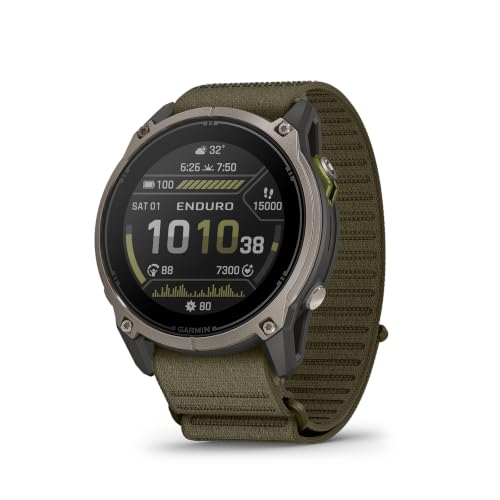 Garmin Enduro 4
51 mm solar MIP watch with a Power Sapphire lens, titanium bezel, up to 90 days of smartwatch battery, faster maps, and 64 GB.
$899.99
Get on Amazon
 11% off
Garmin Enduro 3
The previous Enduro: 51 mm solar MIP with a Power Sapphire lens and titanium bezel.
$799.99
$899.99
Get on Amazon


So you’re basically paying for the new processor and faster maps?
A new processor that barely makes a difference :-) I guess this is Garmin´s new way of making money. The upgrade is the number on the back of the case.
Depends what you need. I have huge garmin eco since more than 10 years – watches, edges, scale, hr strap (actually 3 or 4 one), power meters etc. I had all fenixes, enduro 2, epixes. Last one was fenix 8 pro 51 mm amoled, now I have fenix 9 pro inreach amoled 51 mm. And the difference in UI, smooth, comparing fenix 9 pro inreach to fenix 8 pro is huge, not only in maps. Everything just warking like a charm, no restarts (in fenix 8 pro and fenix 8 I had many times), even widgets warking now as it should before. Of course enduro 4 has not inreach capability, but in my case inreach in fenix 9 pro working a miles better than in fenix 8 pro – and its is because of new SOC and more memory. So basically – even on paper enduro 4 has not big improvements, in real life should working much better than enduro 3. I saw a lot of complaints about enduro 3 on FB groups oraz reddit topics.
I returned my Fenix 9 Pro after been using the 8 pro for quite some time. No difference at all except the cost of upgrading to titanium. This “new” chip barely makes a difference, and even reviewers on YT says the same thing. An overpriced gimmick at best.
Absolutely no :) but of course you have right to say that. In my case there is a huge difference here in Poland, Warsaw. In Fenix 8 pro (I had 2 of them, after software problems – restarts, Garmin send me a new one) live track via LTe-M not working at all, sometimes I had few km lags. Now, with Fenix 9 pro inreach everything working like a charm, because of soc and much more ram. All the software problem (sometimes BT problems still exist) just disappeared, because of the soc and much more ram. Maps are on absolutely different level – you cannot even compare this. Even battery is much better. I am a runner, cyclist, sometimes add gym. Basically 40-50 km run per week, 2h gym (all without phone nearby), with music and have to charge something like in 10 days. With 8 pro, with same settings – AOD, pulse ox only at night and rest default, I need to charge every 7-8 days. Cycling record with edge 1050, so I do not count this.
Don’t forget the new band and a different color case….