

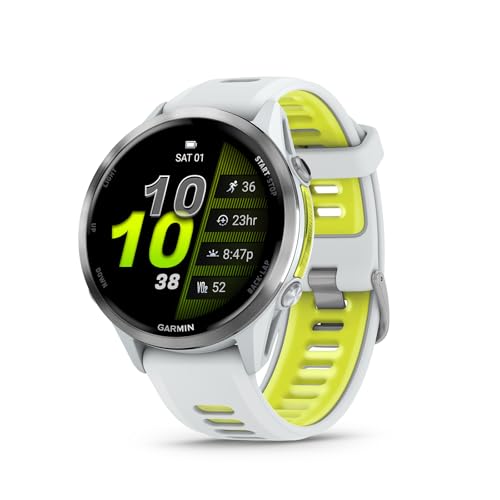
Garmin’s new Forerunner 970 brings the Forerunner line fully into flagship territory, matching the Fenix 8 in nearly every key area of hardware, including a sapphire crystal lens, AMOLED display, and Garmin’s Elevate Gen 5 heart rate sensor with ECG.

The similarities between the 47mm Forerunner 970 and the Fenix 8 AMOLED (47mm) are striking. The 970 even surpasses the latter in several software features while being priced lower.
Shared Features and Core Hardware
Both the Fenix 8 AMOLED (47mm) and the Forerunner 970 include:
- 1.4″ AMOLED touchscreen display
- 47mm case size
- Multi-band GNSS, SatIQ, and 5 satellite systems
- Garmin’s full suite of training, onboard mapping, and performance tools
- 32GB of internal storage for maps and music
- Sapphire crystal lens and Elevate Gen 5 heart rate sensor
- Built-in microphone and speaker for calls, voice assistant, and voice control of the watch
Where the Forerunner 970 Pulls Ahead
The 970 isn’t just catching up — it actually leads in some key areas, thanks to new software features and tracking metrics that haven’t yet reached the Fenix 8 lineup:
- Evening Report
- Past Ovulation Estimates
- Running Tolerance, Impact Load Factor, Running Economy, Step Speed Loss
- Finish Line Suggestions and Projected Race Time/Pace
- Garmin Triathlon Coach and structured multisport workouts
It’s expected that most, if not all, of these software features will arrive on the Fenix 8 via a future firmware update — but for now, they are exclusive to the Forerunner 970.
Where the Fenix 8 Stands Apart
The Fenix 8 remains Garmin’s most rugged and versatile option. While the 970 has leveled up in materials and sensors, the Fenix 8 still offers:
- Available in three sizes (42mm, 47mm, 51mm)
- Offered with both AMOLED and MIP display + Solar options
- 10 ATM water resistance vs 5 ATM on the Forerunner 970
- Dive rating to 40m and inductive leak-proof buttons
- Includes a depth sensor and dive-specific features (not present on the 970)
Battery Life Comparison
When it comes to battery life, the Fenix 8 is a clear winner across every category (except music).
| Mode | Fenix 8 (47mm AMOLED) | Forerunner 970 |
|---|---|---|
| Smartwatch | Up to 16 days (7 days always-on display) | Up to 15 days |
| GPS Only | Up to 47 hours (37h AOD) | Up to 26 hours |
| All Systems | Up to 38 hours (30h AOD) | Up to 23 hours |
| Multi-Band GNSS | Up to 35 hours (28h AOD) | Up to 21 hours |
| Multi-Band + Music | Up to 10 hours | Up to 12 hours |
Price Difference
The Forerunner 970 is priced at $749.99 USD, while the Fenix 8 AMOLED starts at $999.99 and climbs even higher with sapphire and larger models. That’s at least a $250 price gap despite hardware parity (ignoring dive functionality) and new software advantages on the 970.

Bottom Line
The Forerunner 970 now stands shoulder-to-shoulder with the Fenix 8 from a hardware perspective — matching display quality, materials, sensors, and core functionality. Where it pulls ahead is in software: delivering a fresh wave of training and health features first. The Fenix 8 still takes the lead for some use cases, such as the need for better battery life and diving. The Foreunner 970 comes in one size and screen type, whereas the Fenix 8 offers many variations. But if you don’t need those things, the 970 offers more for less and could be the better buy right now.
Takeaway: If you need diving functionality (a depth sensor, leak-proof inductive buttons, 10ATM water rating), extended battery life, or prefer a smaller (43mm) or larger (51mm) case, or want a MIP Solar option, the Fenix 8 is the better fit. But for everyone else, the Forerunner 970 delivers nearly all of Garmin’s flagship capabilities, adds exclusive training metrics, and comes in a lighter, sleeker package — all at a lower price.


Good article. The 970 definately provides more value for money for me, and I don’t need the dive functions. However, where the Fenix pulls ahead for my part is the look and feel of the watch. My personal opinion is the the Fenix simply looks better. Now, is this enough to justify the price gap? Probably not from a rational perspective, but both watches costs a lot of money, so putting in a litle extra to get the better looking watch points me in the direction of the Fenix 8.
There isn’t much of a price gap anymore. The price of the F8 has dropped, most places currently have it priced at $800, which is only $50 more than the 970.
Garmin watches are sold globally, and prices may vary between markets. Looks like you’re based in the US, so unless you’re talking about the Fenix E, there is a price gap of more than $50 on average in general.
Great article. They’ve almost overcrowded their own market.