

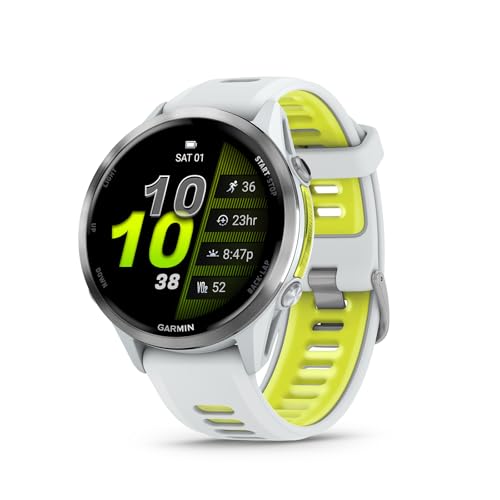
 Forerunner 570 (Left) next to Forerunner 970 (Right)
At a high level, both the Forerunner 970 and 570 bring some major upgrades to the Forerunner series. These include:
- A built-in microphone and speaker for phone calls and voice commands
- Support for Garmin’s new Evening Report feature, similar to the popular Morning Report
- The latest Elevate Gen 5 heart rate sensor for more accurate heart rate and health data
While these improvements are shared, many premium features are exclusive to the Forerunner 970, especially those related to materials, mapping, and performance metrics.
Feature Comparison
Here’s a head-to-head comparison of the Forerunner 970 and the Forerunner 570:
| Feature | Forerunner 970 | Forerunner 570 |
|---|---|---|
| Price | $749.99 | $549.99 |
| Smartwatch Battery Life | Up to 15 days | Up to 11 days (47mm) Up to 10 days (42mm) |
| Built-in Mapping | Yes | No |
| ECG App | Yes | No |
| LED Flashlight | Yes | No |
| Lens Material | Sapphire Crystal | Gorilla Glass 3 |
| Bezel Material | Titanium | Aluminum |
| Memory | 32GB | 8GB |
| Weight | 56g | 50g (47mm) / 42g (42mm) |
| Display Size | 1.4″ (454 x 454) | 1.4″ (454 x 454) (47mm) 1.2″ (390 x 390) (42mm) |
| Speaker and Microphone | Yes | Yes |
| Step Speed Loss / Running Economy / Running Tolerance | Yes (with compatible accessory) | No |
| Golf Support | Yes | Yes |
| Advanced Cycling and Running Metrics | Yes | Limited |
| Power Meter Support | Yes | No |
| Evening Report | Yes | Yes |
| Music Storage | Yes | Yes |
Key Differences
The Forerunner 970 offers more than cosmetic benefits over the 570. The titanium bezel and sapphire lens provide greater durability, while the Forerunner 570’s standard Gorilla Glass and aluminum build keep it lighter and more affordable. Both devices received the latest Elevate Gen 5 HR sensor, but only the 970 can take ECG readings, which is likely a hardware limitation.
One of the 970’s most significant advantages is the inclusion of full-color topographic maps—something not available at all on the 570. If you need real navigation support directly on your wrist, the 970 is the clear choice. Many will be upset to learn that the $550 Forerunner 570 does not offer maps, but it may not be a complete surprise after the $500 Instinct 3 also left them out.
The Forerunner 970 also offers access to newer advanced running metrics like Step Speed Loss, Running Economy, and Running Tolerance (with a compatible accessory).
Both models have microphones and speakers, allowing you to take calls, respond to messages, and control the watch using your voice when paired with a smartphone. However, only the 970 has an LED flashlight — a feature that’s quickly become popular among Fenix and Instinct users.
Both watches are strong in terms of fitness tracking, but the 970 edges ahead with more running and cycling features, making it better suited for multi-sport athletes who want broader activity tracking.
Detailed Battery Life by Mode
Battery life is a major consideration for any endurance athlete or outdoor adventurer. Here’s how the Forerunner 970 and 570 stack up across different usage modes:
| Mode | Forerunner 970 | Forerunner 570 | Forerunner 570 (42mm) |
|---|---|---|---|
| Smartwatch Mode | Up to 15 days | Up to 11 days | Up to 10 days |
| GPS-Only GNSS Mode | Up to 26 hours | Up to 18 hours | Up to 18 hours |
| SatIQ (AutoSelect) GNSS Mode | Up to 23 hours | Up to 16 hours | Up to 14 hours |
| All-Systems + Multi-Band GNSS Mode | Up to 21 hours | Up to 14 hours | Up to 13 hours |
| GPS-Only GNSS Mode with Music | Up to 14 hours | Up to 9 hours | Up to 9 hours |
| SatIQ GNSS Mode with Music | Up to 13 hours | Up to 8 hours | Up to 8 hours |
| All-Systems + Multi-Band with Music | Up to 12 hours | Up to 8 hours | Up to 8 hours |
Final Thoughts
The Forerunner 570 delivers a lot of value by inheriting many of the core features from the 970, including the AMOLED display, Elevate Gen 5 heart rate sensor, and voice functionality. For many runners and general fitness users, the 570 is a solid buy, especially considering the multiple size options (47mm and 42mm).
However, if you want built-in maps, the most durable materials, ECG capabilities, and the latest running dynamics, you will have to accept the premium for the Forerunner 970. But If you want an all black Forerunner 970, without neon highlights, 😬.


Do you think we should expect *970 with LTE support, as they added a mic and speaker?
Not now. But a Fenix 8 pro with LTE seems likely.