

After Garmin’s record Q3 2026 results, the earnings call is where the real story was — and it is why the stock closed down nearly 6% on a quarter that beat on earnings and raised guidance. CEO Cliff Pemble and CFO Doug Boessen spent most of the hour on memory costs, 2027 margins, fēnix 9 and CIRQA demand, Connect+, and Thailand.

The margin warning that sank the stock
Q3 gross margin was a record 63.3%, but Garmin was unusually direct about why that number will not last. Boessen listed three drivers for the quarter: favorable segment mix as Auto OEM shrinks, lower product costs thanks to a weaker Taiwan dollar, and about $33 million in refunds of previously paid tariffs. The memory story is the one that matters for 2027. Pemble, in his prepared remarks:
While it is too early to offer a comprehensive outlook for 2027, we expect our consolidated gross margin profile will return to a historical range primarily due to higher memory costs. We believe a return to historical gross margin levels represents impressive performance given the unusual supply chain circumstances affecting many companies.
Garmin has been running on a safety stock of memory bought before prices spiked. Boessen said memory had only a small impact in Q3, with more coming in Q4 as inventory turns over, and that the Q4 hit is already in the raised guidance. For 2027 he pointed to three moving parts: unfavorable segment mix as the Mercedes-Benz domain controller program ramps, continued higher memory costs, and the usual FX and product mix. No number was given; analysts on the call were working from roughly 58–59%, versus about 61% this year.
Pemble also noted the memory crunch has second-order effects beyond memory itself, including availability and pricing problems with PCBs and cabling, which he tied to the AI build-out.
Pricing is “one of the tools”
Asked about pricing power given that Garmin customers tend to buy on features rather than price, Pemble did not rule out price increases:
Definitely pricing is something that, when I mentioned the mitigations that we can use, it is one of the things that we can look at. It is one of the tools that we have, but we do not overfocus on one particular thing, and we try to get the best balance of all the different ways that we can mitigate cost increases in our supply chain.
He pointed back to the tariff scare a year ago as the playbook: diversification, vertical integration, and products people want. Read between the lines and 2027 watch pricing is at least on the table.
Inventory, prepayments, and less free cash flow
Inventory climbed to about $2.3 billion, up 27% since December, and Q3 free cash flow fell to $293 million from $425 million a year ago. That is deliberate. Boessen said Garmin is executing a strategy to increase inventory of certain components to mitigate the risk of supply constraints, and Pemble added that Garmin makes prepayments to secure supplies from time to time. Asked how those prepayments are structured, Boessen said they are tied to the memory supply situation and negotiated one by one with suppliers to make sure Garmin gets what it needs when it needs it.
The result: full-year 2026 free cash flow guidance is now about $1.1 billion, down from roughly $1.4 billion, with capex around $500 million.
fēnix 9: upgraders first, new users later
Outdoor grew 20% on the fēnix 9 launch, and Pemble said Garmin is still catching up on initial demand. Asked who is buying, he described a familiar pattern:
As has been the history of the fēnix launches, initial demand particularly is very strong from existing users who are upgrading mostly from more than one generation old. It can vary, but the response has been very positive. And then, of course, as the product makes its way further out into the channel, we start to see more new users come to the platform.
On the outlook: “We expect growth momentum to continue in Q4, primarily driven by the fēnix 9 series, resulting in improved full-year growth rates when compared to 2025.” After three quarters of Outdoor shrinking, that is the turn we have been waiting for since the Q2 call teased a busy second half.
The new-user growth is coming from elsewhere. Pemble said the new user profile outside of fēnix is heavily weighted toward first-time Garmin owners, naming CIRQA, vívoactive, and the entry-level Forerunner 70 and 170 as the products pulling significant numbers of new users into the ecosystem.
CIRQA still cannot be made fast enough
One quarter after Garmin said it would be “chasing back orders for a while,” nothing has changed:
The demand that we have been experiencing for CIRQA is very strong and definitely exceeded our expectations, which is what I like to call a happy problem. And so we are working hard to expand our production and to fill all of the orders that we have.
Asked whether shoppers are walking into a store, seeing CIRQA, and trading up to a watch for a little more money, Pemble said Garmin does not have strict data on that, and that CIRQA buyers are choosing it specifically for the screenless approach and the flexibility to wear it alongside other devices.
Connect+ is outrunning the hardware
The subscription is growing faster than the segments it sits on, which Pemble conceded is partly the small base, but the retention commentary was the notable part:
Connect Plus has outpaced our expectations and the renewals and the commitments after the free periods have been very strong. And even products that you would not suspect would be of interest for Connect Plus, particularly CIRQA, people are also signing up for Connect Plus to get more out of CIRQA.
On the question everyone asks, whether new features will be gated behind the subscription, Pemble confirmed Garmin is “already doing that today in terms of features like nutrition,” while framing the general approach as rich features on the device first, with “more” available through Connect+ for those who want it. He also mentioned a long-term roadmap to expand Connect+ further.
Fitness: registrations outran sell-in
Fitness grew 16%, the slowest quarter of the year after 42% in Q1 and 25% in Q2, and revenue was down sequentially from Q2. Pemble’s explanation was the channel, not the customer:
Our registrations did outpace our sell-in. So there is some implication there that the channel is destocking a little bit, probably because they are getting ready to bring in more stock for the holiday season. But the demand for our products and the pull-through at the registration level is very strong.
He added that retailer interest in Q4 promotions is “very strong,” that Garmin has a significant backlog it is working to fill for the fourth quarter, and that Fitness should still be the strongest contributor to full-year growth.
Competition: “catching up to what we have known all along”
Asked about the increasingly crowded wearables market, Pemble’s answer was that the players are well entrenched and that rivals are now converging on Garmin’s thesis:
Many of them are catching up to what we have known all along, that health and fitness are very important drivers of interest in wearables. And so we are continuing to lead, I believe, in terms of product features and sensor capabilities and the ability to help a user on their journey.
Thailand: Q1 2027, and “desperately” needed
The new factory is on schedule:
We are on track to open the new facility, expected to start producing new products in the first quarter of ’27, and it is something we desperately need as our volumes have basically reached our capacity. So we are excited to bring more capacity online.
Boessen confirmed the facility’s costs start flowing through the P&L once production begins in Q1 2027, which is one more small headwind in next year’s margin math.
Quick hits
- Auto OEM: Q4 revenue will fall year over year again as legacy domain controllers wind down; the Mercedes-Benz program starts contributing early in 2027 and builds from there, following Mercedes’ production schedule.
- Marine: Pemble called the end market “a little bit soft” in the off-season, with high fuel prices a factor, but said refits and mid-range new boats are bright spots and the sonar lineup, led by LiveScope 2, is doing the work.
- Tariff refunds: Most have been received; a smaller amount may land in Q4 or 2027 and is not in guidance.
- Drones: Asked about the category, Pemble called consumer drones a mature, saturated market and said military drones are not a focus.
The takeaway for the watch crowd: demand is not the problem. fēnix 9, CIRQA, and Connect+ are all running ahead of what Garmin planned for. The problem is the cost of building them in 2027, and Garmin just told you pricing is one of the ways it intends to deal with that.
 Garmin Fenix 9 (51 mm)
Flagship adventure watch with the largest AMOLED display in the fēnix lineup, titanium case option, maps, and multi-week battery.
$1,099.99
Get on Amazon
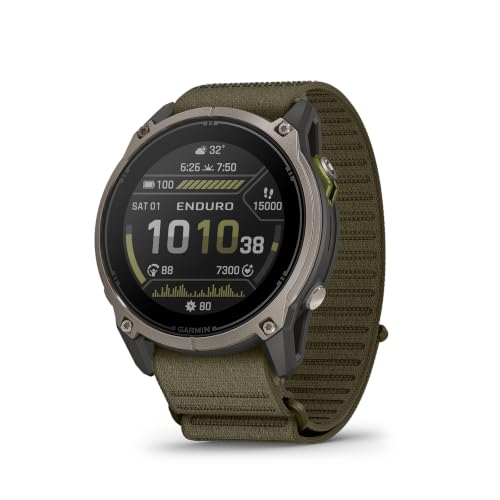 Garmin Enduro 4
51 mm solar MIP watch with a Power Sapphire lens, titanium bezel, up to 90 days of smartwatch battery, faster maps, and 64 GB.
$899.99
Get on Amazon


Join the conversation. A free account lets you comment, reply and say how updates are running.
Sign up freeSign in
No comments yet. Start the conversation.