

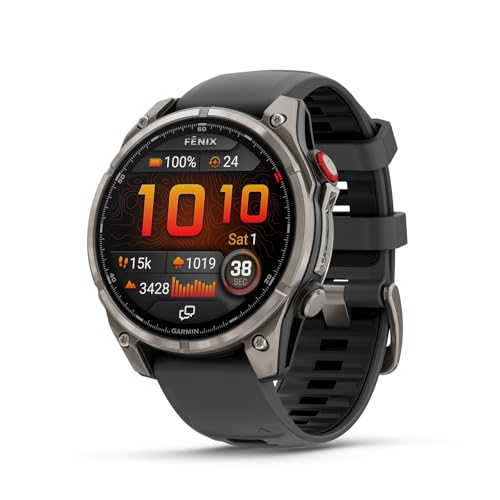
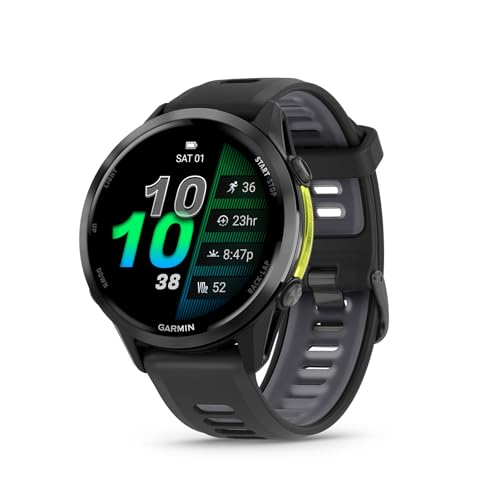
On paper, the Fenix 8 Pro looked like my dream upgrade from the Epix (Gen 2) — but once it was on my wrist, the slimmer, lighter Forerunner 970 made a lot more sense.

- Larger display without increasing the case size
- Mic and speaker
- The now-beloved Garmin flashlight
- ECG support
- Updated training features and software
- And, of course, the big headlines: LTE and Satellite support
I ordered it immediately, fully expecting this to be my next long-term watch. But as soon as I put it on, I got cold feet.
1. The Thickness Jump Was Small on Paper — But Noticeable on the Wrist
Here’s how the Fenix 8 Pro compares to my Epix (Gen 2) Sapphire:
Epix (Gen 2) Sapphire: 14.5 mm
Fenix 8 Pro (47 mm): 16.0 mm
Difference: +1.5 mm (about 10.3% thicker)
That 10% doesn’t sound like much on a spec sheet, but on the wrist it was obvious. My Epix was never a “slim” watch, but adding more thickness — despite all the generational improvements — felt like a step backward in daily wearability. The Fenix 8 Pro looked and felt chunkier than I wanted for the next four years.

2. LTE & Satellite Are Impressive… I Just Don’t Actually Need Them
I genuinely appreciate Garmin pushing connectivity forward, and for many athletes, LTE plus Satellite is a dream feature set:
- People who absolutely hate carrying their phone
- Runners who want messaging and safety without any extra device
- Athletes who go off-grid where Satellite features make a real difference
But for me, that’s not really the case. I almost always have my phone with me. It’s never felt like a burden. I often run without headphones, but when I do listen to something, it’s usually Audible — which Garmin still doesn’t support natively. (Where is the Audible app?)
I also want the option to use Google Maps, reply to normal texts, or make regular phone calls. LTE on the Fenix 8 Pro funnels everything through Garmin Messenger, which means the recipient has to interact through Garmin’s ecosystem too. That’s not ideal for my day-to-day use.
And as for satellite emergencies: in the rare scenario where I’d actually need help, my iPhone’s satellite SOS is more than enough. So while I applaud Garmin for the technology, I realized I’m not actually the target customer for LTE or Satellite right now.
3. The Forerunner 970 Felt Better and More Modern on My Wrist
This is what finally pushed me over the edge. I had recently bought the Forerunner 970 for my brother, and when I compared it side by side with the Fenix 8 Pro, it hit me: the 970 has almost everything the Fenix 8 Pro offers without the bulk.
Epix (Gen 2): 14.5 mm
Fenix 8 Pro: 16.0 mm (+1.5 mm / +10.3%)
Forerunner 970: 12.9 mm (–1.6 mm / –11.0%)
So instead of increasing the thickness of my watch by 1.5 mm (+10.3%) with the Fenix 8 Pro, I was actually able to decrease it by 1.6 mm (–11.0%) by choosing the Forerunner 970.
No LTE, no Satellite, no dive modes — but I don’t need those. What the 970 does have is:
- Titanium bezel
- Sapphire lens
- The same core training, mapping, and health features for my use
- A noticeably slimmer profile
- A more modern, sleek feel on the wrist
- Great weight-to-durability ratio
- A lower overall price
And at $749.99, the Forerunner 970 also saves about $450 compared to the $1,199.99 Fenix 8 Pro. It still feels rugged — it’s not some fragile, fashion-first watch — but it manages that while being slimmer and lighter. On my wrist, it felt like a clear upgrade over the Epix, whereas the Fenix 8 Pro felt more like a lateral move with extra bulk.

4. The Only Real Downside: Golf Still Favors the Fenix Line
The one place the Fenix lineup still clearly wins is golf.
The Forerunner line, including the 970, doesn’t have full vector golf maps, so you don’t get the hole-overview graphics that Fenix and Epix owners enjoy. This is something Garmin should absolutely fix, because the hardware in the 970 is more than capable of handling it.

If golf is a big part of how you use your Garmin, the Fenix 8 or Approach series may still make more sense.
Final Thoughts
The Fenix 8 Pro is a powerhouse and the most feature-packed watch Garmin has ever made. But for my actual use case of running, daily wear, training insights, and wanting less bulk, not more, the Forerunner 970 was the better match.
It delivers nearly all of the performance and capabilities of the Fenix 8 Pro (minus dive and cellular/satellite) without the extra thickness, weight, or connectivity features I don’t really need. In my opinion, the Forerunner 970, at its size, thickness, weight, and price, is one of the best watches Garmin has ever released.
If you’re still deciding between the Fenix 8 Pro, Forerunner 970, or any other Garmin model, our Garmin Watch Comparison Tool makes it easy to compare size, weight, battery life, mapping, sensors, and every major feature side-by-side.


Join the conversation. A free account lets you comment, reply and say how updates are running.
Sign up freeSign in
Well, you bought the wrong Fenix 8. The non pro Fenix 8 is only 13.8mm thick, even slimmer than your Epix. 🤷 And it still have vector golf mode, the dive features, and flash light.
You’re right. I bought Fenix 8 Amoled 47mm Sapphire Titanium over FR970 not because of the features but F8 is much more nicer. FR 970 is simply boring. And the F8 Pro’s features are unnecessary.
Hi Fenix 8 is more rugged, less sleek than FR 970. If you want to look like adventure with prominent screws around the bezel as if you are aalways in adeventure/mountain mode by all means choose fenix. Choose FR 970 if you want refined more subbtle look specially in black looks like a normal watch and not rugged, bulky.
Plus FR970 can hide under long sleeve and blazers but fenix is more difficult to hide due to its thickness for example.
Really great overview, and exactly the same reason I returned my Fenix 8 Pro and went with the 970. As a golfer myself, it is annoying how the 970 which is the top of the line for the Forerunner range, doesn’t have the full golf feature set.
Thanks for sharing. Yes it’s to bulky for asking price.
Great overview. Thank you.
Love my FR970, too. (Just waiting on improved GPS for city runs.)